
How to Get Good at Muay Thai Fast: 10 Honest Facts (Sorry)
You clicked on an article called "How to Get Good at Muay Thai Fast" and the first thing I'm going to tell you is to slow down.
I know. I'm sorry. But also not sorry…
But if there's one thing 20 years of training and 15 years of coaching has taught me, it's that the people who chase fast progress are almost always the ones who end up stalling. The ones who slow down, accept where they are, and stop white-knuckling their own improvement? They're the ones who end up genuinely good.
There's no McDojo shortcut here. No magic combination that unlocks your inner Saenchai. No belt system to game, because - spoiler - Muay Thai traditionally doesn't do belts. More on that in a second.
Here are 10 honest facts about getting good at Muay Thai. Some of them will annoy you. That's fine.
1. Be Prepared to Take Things Slow
Ironic opener for an article about getting good fast, I know.
But if you can genuinely slow down, start from scratch, and learn to breathe through the moments where you feel like you should be further along by now, you will improve faster than almost anyone else in the gym.
If mastering Muay Thai were as simple as clocking Street Fighter, we might as well hand you a black belt and call you Master. It isn't. It requires patience from people who are not naturally patient, humility from people who are not naturally humble, and the ability to drill the same kick ten thousand times without dying of boredom.
The good news: the 10,000th rep feels completely different from the first.
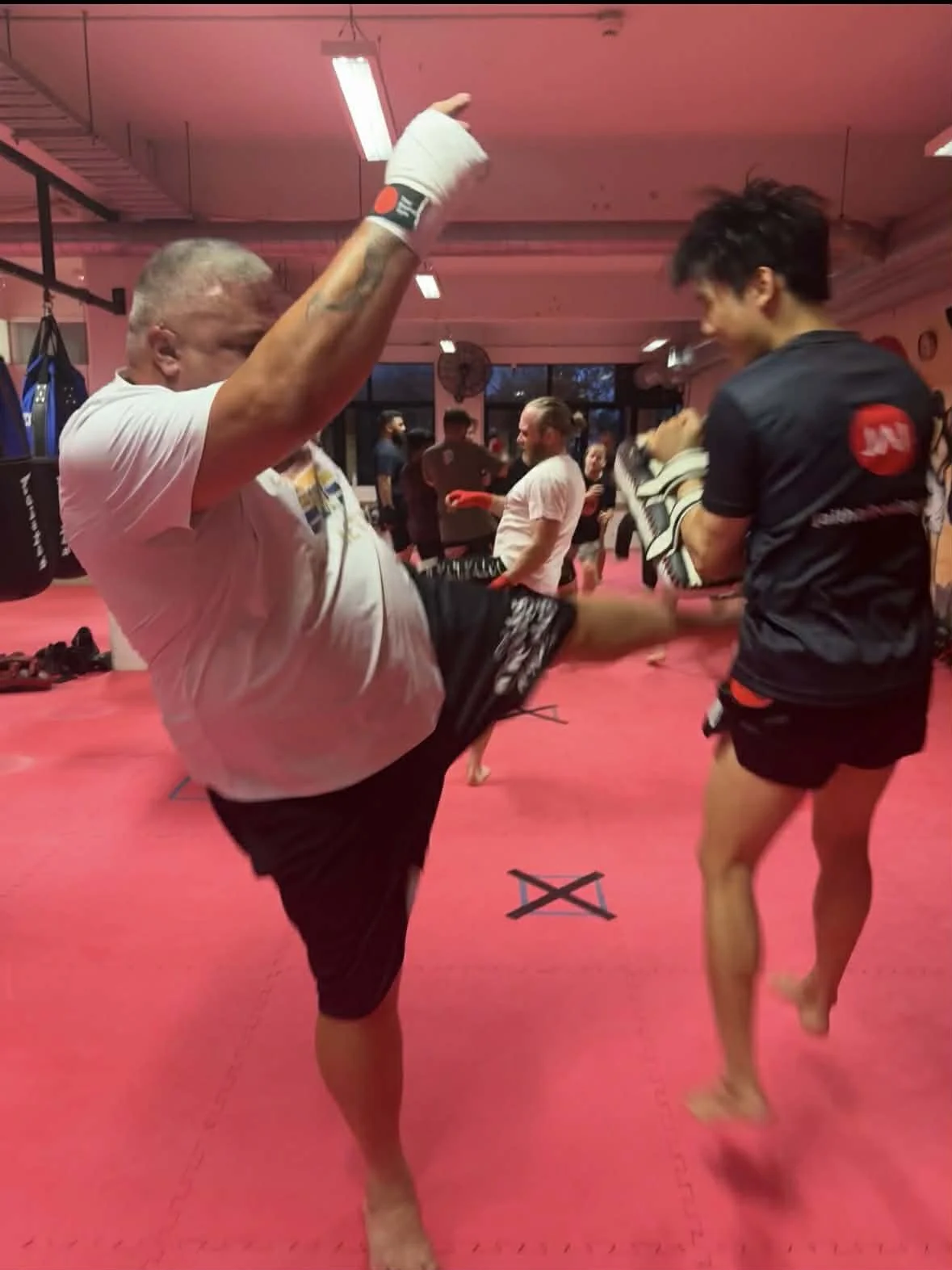
Jeremy at 170kg proving now is the best time to start
2. Be Humble (Also: Muay Thai Has No Belts)
Speaking of black belts, Muay Thai doesn't have any. Unless you count the shiny type you earn in the ring, which frankly isn't very comfortable to train in.
This means that unassuming guy in the ratty shorts and the bowl haircut? Could be a Muay Thai champion with 50 fights. Or he might just have bad fashion sense and a bad haircut. The point is: you cannot rank people by their outfit. Everyone on the mats deserves respect, regardless of how long you've been training or how many YouTube videos you've watched.
If someone offers you a pointer - listen. Thank them. Then decide whether it works for you. That last part matters. Check on your toes for more height or check on a flat foot for more stability? The correct answer is…. blind deference isn't the goal. Genuine open-mindedness is. And yes. Both work.
This is also, by the way, the entire reason we have a no-ego policy at JAI. A gym full of people trying to prove something is a gym where nobody improves. A gym full of people trying to learn something is where everyone improves - including the people who've been doing it for years.
3. KISS: Keep It Simple.. Stupid
There's no point learning to fly before you can walk.
Don't expect to learn something new every week when you haven't yet mastered a basic roundhouse kick. And just so we're clear, there is no "basic" roundhouse kick. There's always someone who kicks harder, faster, and with better timing than you. That's not discouraging. That's just the sport.
It may take tens of thousands of reps of the same move before you see a measurable improvement. Most people won't do this. They get bored, they move on, they want the next thing.
The people who will drill one kick for an entire session, then go home and do it again in their living room? Those are the people who look frightening six months later.
So what are you waiting for?
4. Leave the Fancy Moves for Hollywood (or the Professionals)
Dropping your guard to taunt your opponent might make you look like you know what you're doing. It also increases your chance of getting KTFO by approximately 300%.
Spinning elbows, cartwheel kicks, and jumping techniques are not beginner moves. They are not even intermediate moves in most cases. They are moves that professional fighters with thousands of hours of training throw at opponents they have already read, timed, and outclassed.
The best fighters in the world built their reputations on devastatingly good basics - not trick shots. A perfect teep thrown at the right moment is more dangerous than any flying knee you've seen on a highlight reel.
Pack the fancy stuff away. Get your basics so sharp they're frightening. Then, and only then, add layers.
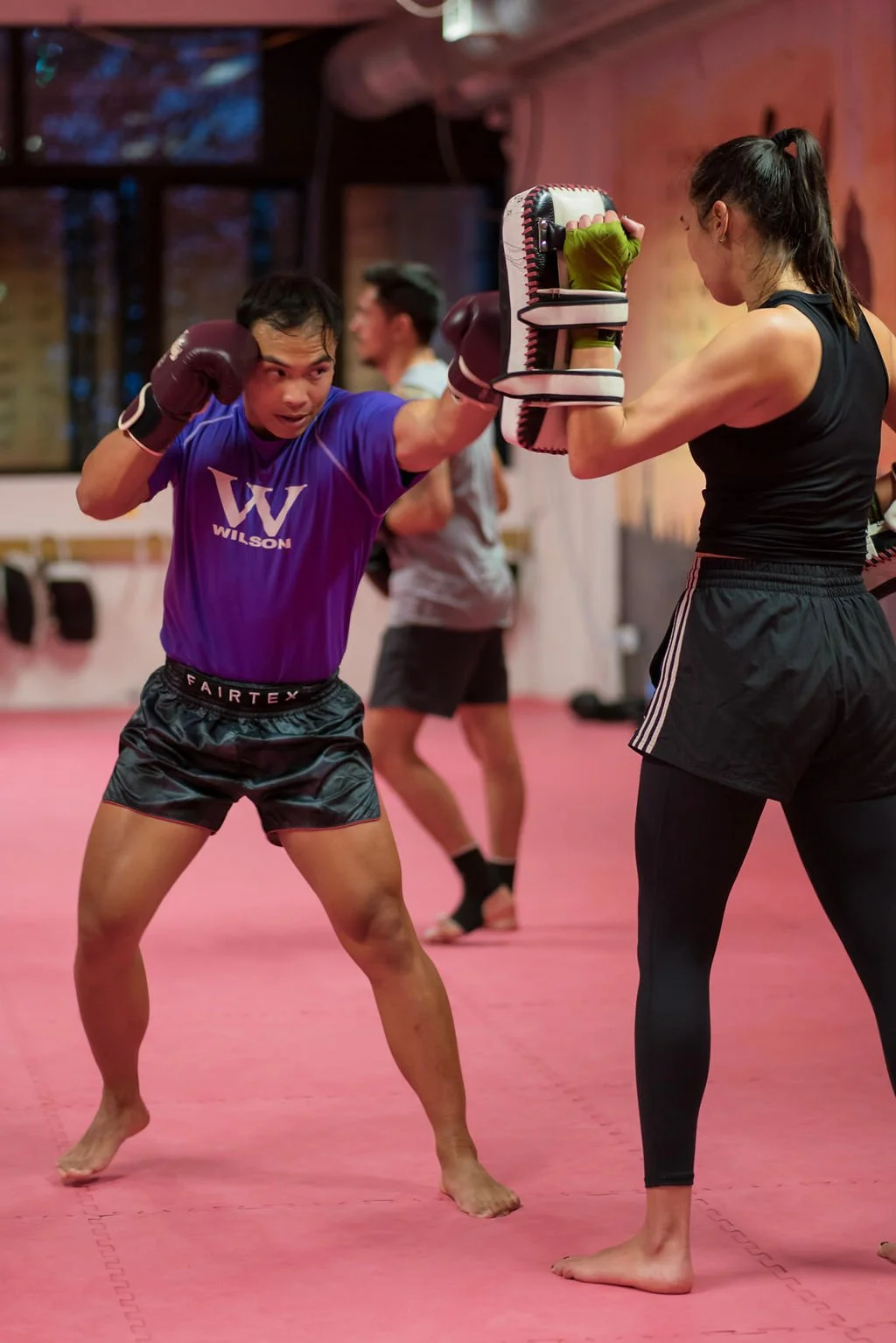
The jab is probably one of the most effective strikes every. And after 10,000 jabs we’re still finding ways to improve it
5. Stop Making Excuses
Legs too tired. Gym too far. Too much work. Kids. Weather. Need to wash hair.
Fine. If you want to be mediocre, any excuse will do.
But this article is about getting good at Muay Thai, not about maintaining a gentle relationship with the idea of training. If you train less than twice a week, seeing meaningful improvement in either fitness or technique becomes genuinely difficult. The sessions are too far apart. Your body forgets. You spend the first half of every class catching up to where you were last week.
Our fighters train at least five days a week. If you're in Thailand, double that and add two more sessions and about 50km of extra road miles a week. We're not asking you to go to Thailand, we're just saying the excuses that feel significant here in Auckland CBD are not exactly legendary obstacles.
Show up. Consistently. The rest follows.
6. Train Smart, Not Just Hard
We get people coming in who want to kick down coconut trees after their first class.
They slam their shins into the bags (and sometimes even beat them with rolling pins) as hard as they possibly can, then hobble out after class and call us the next day saying they can’t walk up stairs. This is not training smart. This is enthusiasm without direction, which in martial arts tends to produce bruises rather than skill.
Training smart means picking one specific thing to improve each session - your balance on the teep, the angle of step before your roundhouse, the rhythm of your combinations, and actually working on it. Not just hitting things as hard as you can until you're too tired to hit anymore.
By picking one technical focus per session and drilling it with intention, you will see better results than a month of mindless bag work. Your trainers at JAI will help you identify what that one thing should be, if you ask them. Which brings us to:
7. Do Your Homework
Don't expect everything to come from class time alone, especially if you're only training two or three times a week.
Thanks to the internet, you have access to footage of the greatest Muay Thai fighters who ever lived, for free, on your phone, right now. Rodtang. Saenchai. Buakaw. Dieselnoi. Watch them. Not just the highlight compilations - watch full fights. Watch how they set things up. Watch their footwork between exchanges. Watch where their hands are when they're not throwing. Study how they think, not just what they throw.
You don't need to be able to replicate what they do immediately. You just need to start training your fight IQ alongside your physical technique. The two develop together, and fighters with good fight IQ improve at a rate that genuinely baffles the people around them.
Speaking of which, watch yourself too. Not your highlight reel. Take videos of your training to see your progression (but check that other people in the video are ok with it too). It helps you track real progression overall, not just on days when you’re feeling like Buakaw.
8. Accept Your Limitations (and Work With Them)
Everybody wants to be a Muay Femur like Saenchai, a technical, stylish fighter who makes everything look effortless and beautiful. And why wouldn't you? They look incredible.
But the sooner you accept your actual physical strengths and work with them instead of against them, the faster your progress will be.
Long and rangy with good reach but slower on the reflexes? Muay Khao - the knee-fighting style - might suit you beautifully. Aggressive, with fast hands and good timing? Muay Mat could be your calling. Stocky and low to the ground with powerful legs? Your roundhouse could be your best weapon.
This doesn't mean you ignore the techniques that don't suit you. The more complete your arsenal, the more dangerous you are. But keep the weapons you actually land extra sharp, and don't spend years trying to fight like someone whose body is completely different from yours.
9. Be Prepared to Lose
The biggest battles in Muay Thai aren't always fought in the ring.
They're fought with your pride. With your expectations. With the gap between who you think you are and who you currently are at 7:30pm on a Tuesday night in Auckland CBD.
You can do everything right - the sessions, the drilling, the diet, the mental preparation - and still lose. Because sometimes the other person is better than you on that day. Sometimes they're just having a better day than you. That's not a failure of your preparation. That's sport.
If the thought of losing just makes you want to train harder and come back better, you probably have a long career in this game.
If you can't handle the possibility that the hand raised at the end might not be yours - you can either fight tuk tuk drivers in Chiang Mai, or find a different sport.
10. Get Beat Up by Everyone
Some of the best fighters in the world started with nothing more than kicking rice sacks and sparring much bigger, much better opponents in conditions that make our Auckland CBD gym look like a five-star resort.
When you get outclassed in sparring - and you will - don't get angry. Don't sulk. Don't immediately start plotting revenge. Thank them, tell them you'd love to go again, and go home and figure out what they were doing that you couldn't answer. Don’t forget to add them as a friend on Gym Master so that you can check when you can get round 2, or 99 in.
With more experienced training partners, you'll improve fastest by being a good target. Let them work. Absorb what you can. Ask questions. In terms of the ability to grow, this is one scenario that it works in your favour to be the worst in class rather than the best.
With less experienced partners, or even people who are as experienced or stronger, try things you normally wouldn't. Work your southpaw stance. Use the techniques you're less comfortable with, pull back on power and focus on accuracy, timing, and technique, not on proving something. The less experienced / smaller person is trusting you. Respect that. Otherwise word gets round.
The last person anyone wants on the mats - and the last person anyone will ever help improve - is a bully. And the people who improve fastest at JAI are almost always the ones who everyone wants to train with.
TLDR: The Short Version
You want to get good at Muay Thai fast? Here it is:
Slow down. Be humble. Keep it simple. Leave the Hollywood moves alone. Stop making excuses. Train with your brain, not just your body. Do your homework. Work with your strengths. Accept that you'll lose sometimes. And let the better people teach you.
None of this is a secret. All of it is harder than it sounds.
If you're ready to actually start, or start again, your first JAI 101 class is completely free.
👉 Book Your Free Muay Thai Trial at JAI Auckland CBD Today
Frequently Asked Questions
How long does it take to get good at Muay Thai as a complete beginner?
Most beginners develop functional, recognisable Muay Thai within 3 to 6 months of consistent training at 2 to 3 sessions per week. Within a year of showing up consistently, most people are genuinely surprised bytheir own level. The key variable is not time - it's consistency.
Is Muay Thai hard to learn for beginners?
The fundamentals are more accessible than most people expect. Stance, guard, and basic strikes are biomechanically intuitive. What takes time is developing the coordination to link techniques fluidly under pressure - and that comes from repetition, not talent.
How many times a week should a beginner train Muay Thai to improve fast?
Two to three times per week is the ideal starting frequency. Less than twice a week and too much of each session is spent catching up from the last one. More than four times in the first few months often leads to minor injuries before the body has adapted.
Can I get good at Muay Thai without sparring?
Yes. The majority of JAI members train purely for fitness, skill, and the enjoyment of the sport with no interest in sparring or competing. You can develop excellent Muay Thai through bag work, pad work, and technical drilling. At JAI, sparring is always optional and only available to intermediate members after trainer clearance.
Does Muay Thai have belts or ranking systems?
No. Traditionally Muay Thai does not have a belt ranking system. Progression is assessed by trainers based on technique, attitude, and readiness - not by how long you've been training or how many classes you've attended. This is one of the things that keeps Muay Thai honest. You cannot buy your way up a ranking system but you can ask for feedback and how to improve. Try our skills testing sessions as one way to get a good gauge on what you’re doing well in and what you need to work on.
What's the difference between JAI 101 and a regular Muay Thai class in Auckland?
JAI 101 is a structured beginner program for people who need to work on the fundamentals. The focus is on short combos and correcting single movement techniques. Unlike a general class where beginners are mixed with experienced members, JAI 101 is a dedicated space where everyone is at the same stage, with a trainer whose goal is to get everyone to improve technique after every session.

